
Virginia’s operators prepare for SSI MACT Rule March 21, 2016 deadline for Operator Training & Qualification (OT&Q)
On 15-APR-2015, the Hampton Roads Sanitation District (HRSD) hosted a Water Environment Federation (WEF) WEFMAX training to provide sewage sludge incinerators (SSI) maximum achievable control technology (MACT) rule (see, http://www.gpo.gov/fdsys/pkg/FR-2011-03-21/pdf/2011-4495.pdf) required operator training and qualification under 40 CFR 60.5130(a-c) for water resource recovery facilities in the Commonwealth of Virginia that operate SSIs. Attendees of the event who met the criteria set forth through the training and examination received approval for meeting the provisions of 40 CFR 60.5130(c) as required in Virginia statutory code 9VAC5-40-8270. This is the first-of-its-kind training in the nation developed to meet the OT&Q requirements of the SSI MACT rule that has been granted state approval by Virginia’s Department of Environmental Quality Air Division.
Under the SSI MACT rule, operators are required to be in compliance no later than 21-MAR-2016, ensuring that SSIs operating under Title V permits meet the obligatory certified and approved operator training required in order to be in compliance with the law. Subject matter experts that made the program a complete success included:
- James Welp, PE, BCEE, Vice President, Black & Veatch,
- Robert P. Dominak, PE, BCEE, President, Friar Consulting Inc.,
- Mark Feltner, Environmental Scientist, HRSD, and
- Arba Williamson, Water Quality Specialist, HRSD.
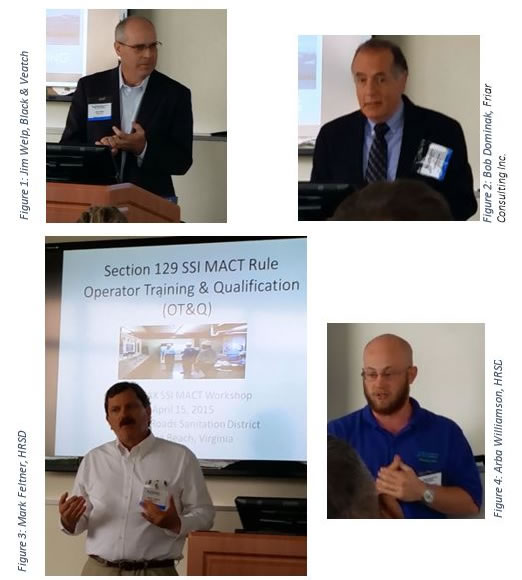
The WEFMAX training and examination was specifically designed for experienced SSI operators that have been trained on the job and have, for a minimum of one year, demonstrated the ability to operate the SSI in compliance with the facility’s existing applicable air permit and regulations and to maintain the integrity of the process (and its equipment), all while achieving the purpose of the SSI pathogen destruction and solids reduction, or has been a supervisor with more than three years of experience directly overseeing SSI operators who have the aforementioned qualifications.The training provided a rigorous curriculum that began with an historical perspective. Jim Welp provided a look back at 1993 and compliance with 503 regulations, from the installation of THC monitors and implementation of NOx studies to meeting emission limits, noting that the pretreatment program has been a great success story. Since 1993, “we’ve learned that compliance is possible . . . incineration is a viable solids handling option with a low life-cycle cost, requiring limited space, providing low traffic in the community, killing pathogens, and providing excellent opportunity for resource recovery, such as phosphorus. Bob Dominak detailed the background, requirements, legal, and implementation issues associated with the rule. He provided answers to questions, such as “do the emission guidelines, new source performance standards, and operating limits apply during startup, shutdown and malfunctions?” [Note: the answer is YES]. Additional information was imparted, such as SSIs are required to meet not only the SSI MACT standards, but also other applicable requirements, such as Title V, Part 503, state and local operating requirements, among others. Emissions Guidelines for existing multiple hearth incinerator (MHIs) and fluid bed incinerators (FBIs) are enforced either through a state implementation plan (SIP) or a federal implementation plan (FIP). A draft pre-publication version of the FIP was posted on 07-APR-2015 for review at http://www.epa.gov/ttn/atw/129/ssi/20150408fr.pdf. The actual draft FIP will be published in the Federal Register in either late April or early May 2015. Comments will be due 45-days after publication. WEF’s Residuals and Biosolids Committee will be working with the Government Affairs Committee and other interested organizations in reviewing and submitting comments on the draft FIP. They are also compiling a list of SSI MACT related implementation issues that will be submitted to U.S. EPA. Mark Feltner and Arba Williamson of HRSD provided a thorough review of Virginia OT&Q requirements, and instructed participants on the 10 required subject areas required of operators, which include:
- Environmental concerns
- Basic combustion principles
- Operation of type of SSI (MHI or FBI)
- Combustion controls and monitoring
- Operation of air pollution control equipment
- Inspection/maintenance of SSI & control devices
- Actions to prevent malfunctions
- Ash characteristics & handling procedures
- Applicable regulations
- Pollution prevention
Two case study presentations contributed to the operator instruction. Mark Feltner provided “A Case Study of 10 Multiple Hearth Incinerators (MHIs) and the new MACT 129 Regulations,” and Bob Dominak provided “Achieving Compliance with Fluidized Bed Reactors.” In addition to the case studies, Jim Welp rounded out the discussions with a presentation on SSI MACT implementations issues and concerns. All operators must meet the training requirements in order to ensure compliance with the rule by 21-MAR-2016. Under the pre-publication FIP, issued 07-APR-2015, section “F” requires that “the owner or operator must qualify operators or their supervisors (at least one per facility) by ensuring that they complete an operator training course and annual review or refresher course. (See 40 CFR 62.15920 through 62.15950.) The FIP also contains operator training and qualification requirements that correspond to the 2011 [emission guidelines].” States additionally have training requirements that correspond to the rule. Participants at the 15-APR-2015 WEFMAX training were provided with the opportunity to train and test as a pathway to state approval and compliance. As a result, quite a number of Virginia operations are now OT&Q compliant.
Additional Resources:
- U.S. EPA Technology Transfer Network – Air Toxics Web Site, Sewage Sludge Incinerators (SSI), http://www.epa.gov/ttn/atw/129/ssi/ssipg.html
- Pre-publication version of the “Federal Plan Requirements for Sewage Sludge Incineration Units Constructed on or Before October 14, 2010“, U.S. Environmental Protection Agency, 07-APR-2015.
- “Thermal Oxidation Fact Sheet,” Water Environment Federation, Residuals and Biosolids Committee Bioenergy Technology Subcommittee, MAY-2014, http://wrrfdata.org/ThermalOxidationFS/WEF-ThermalOxidationFactSheet2014.html
- WEF Manual of Practice No. 30, “Wastewater Solids Incineration Systems,” WEF Press, 2009.
- “Solids Process Design and Management,” WEF Press, 2012.
- Title 40, CFR, Part 60 – Standards of Performance for New Stationary Sources and Emission Guidelines for Existing Sources: Commercial and Industrial Solid Waste Incineration Units, Federal Register (Vol. 76, No. 54, 15372-15454, March 21, 2011, see, http://www.gpo.gov/fdsys/pkg/FR-2011-03-21/pdf/2011-4495.pdf
- National Biosolids Partnership
- Water Environment Federation
Facebook
Twitter
Youtube